Distribution loops
A distribution loop carries treated water from the reverse-osmosis plant to each dialysis station and back in a controlled circuit. We design, install and service loops for dialysis units in KwaZulu-Natal, with practical layouts, clean workmanship and records kept by the unit’s testing schedule.
What a distribution loop does
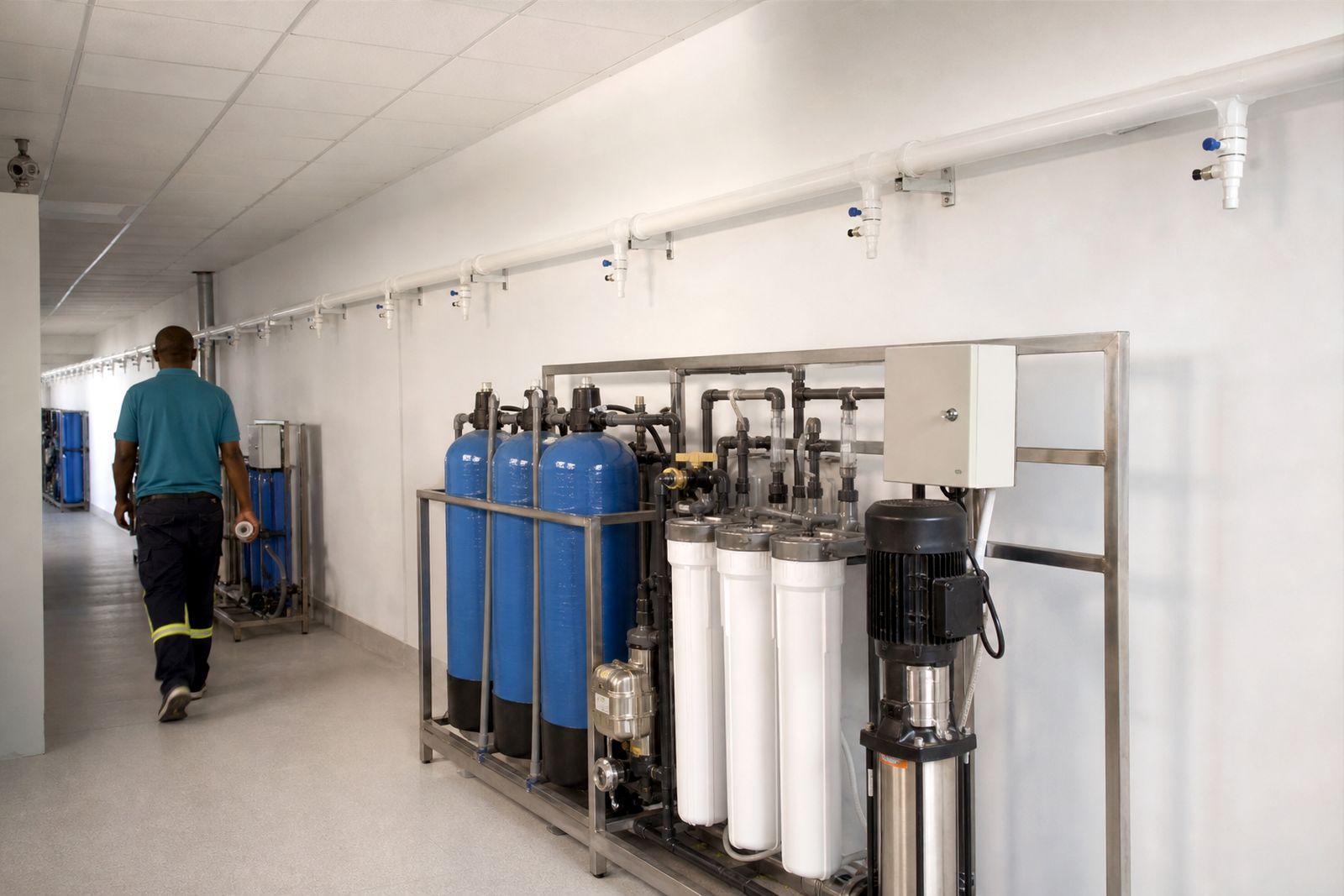
In a dialysis unit, the loop is the treated-water pipework that runs from the RO plant to the treatment area and returns back to the plant room. Its job is to keep water moving through the circuit so that each station receives treated water consistently, while giving the unit clear points for sampling, disinfection and routine checks.
We supply and install loop pipework as part of a full water plant package or as an upgrade to an existing system. Our work covers the route from the plant outlet, through the clinical area, and back to the return connection, with attention to fittings, supports, valves, drain points and practical access for service. The responsible staff at the unit set the testing schedule and limits, and we keep the records that go with the plant.
Loop sizes and configuration options
There is no one-size-fits-all loop. The right arrangement depends on the number of stations, the building layout, the distance between the plant room and treatment area, ceiling space, and how the unit wants to sample and disinfect the system. We plan the route to keep it direct and serviceable, with as few dead legs as possible and clear return flow back to the plant.
- Compact loops for small units where the plant room sits close to the treatment area.
- Longer perimeter loops for wards with stations along more than one wall.
- Overhead routed loops where floor space is tight or where wall services must stay clear.
- Plant-room to ward connections with a dedicated return line back to the RO system.
- Sampling points placed where the unit needs routine checks recorded.
- Isolation points arranged so sections can be worked on with less disruption.
Pipe diameter and branch details are selected to suit the route and the intended flow pattern. We avoid over-complicating the run, because a simple well-supported loop is easier to clean, inspect and maintain. In coastal conditions around Durban and further up the KwaZulu-Natal coast, material choice and support spacing matter, as warm humid air can be hard on plant rooms and ceiling voids.
Where it suits and where it does not
A dedicated distribution loop suits dialysis units that need treated water delivered to more than one station from a central RO plant. It is also the right approach where the unit wants one managed route for sampling, disinfection and return circulation rather than separate short runs to each point of use.
- Suited to fixed dialysis stations in a permanent treatment area.
- Suited to new build-outs where pipe routes can be planned early.
- Suited to refurbishments where an older loop needs replacement or rerouting.
- Useful where the plant room is separate from the treatment room.
It is less suitable where stations move often, where access above ceilings is severely restricted, or where the building cannot provide a sensible return route to the plant room. In some sites, a proposed route may pass through areas that make future service too difficult or may clash with other services and municipal plumbing requirements. In those cases we will say so plainly and suggest a more workable layout. We do not give clinical advice, but we do point out installation issues that affect maintenance and record-keeping.
Site and installation requirements
Before installation we need a clear picture of the space. In Pinetown, Durban and many KwaZulu-Natal facilities, older buildings often have mixed plumbing, low ceiling voids or later additions that affect the route. A site survey lets us confirm the plant location, treatment-room layout, access times, drainage points and practical fixing positions.
- Measured route from the RO plant to every station position and back to the return point.
- Access to ceiling voids, wall chases or service ducts.
- Suitable supports and fixing surfaces for the chosen pipework.
- Space for sample points, isolation valves and drain-down points.
- A workable path that does not interfere with other essential services.
- Planned shutdown windows so the unit can prepare around the work.
Installations are carried out with attention to clean routing and labelled components, and we coordinate practical commissioning with the rest of the water plant. If a site has frequent power cuts, we also look at how the loop and plant restart procedure will affect the unit’s daily checks and operating routine.
Care, cleaning and service support
A distribution loop needs routine attention even when it is running normally. The main points are visual checks, leak checks, support condition, valve operation, insulation where fitted, and scheduled disinfection as set by the unit and its responsible staff. We can assist with planned service visits and disinfection support as part of a wider contract for the dialysis water plant.
During service we inspect the loop route, check accessible joints and branches, confirm that labels and sample points are still clear, and note anything that could affect future testing or disinfection. Small issues caught early usually prevent bigger shutdowns later, and that matters in a busy unit.
- Routine visual inspection of pipe runs and supports.
- Checks for drips, staining, movement or damaged insulation.
- Verification of accessible valves and sample point condition.
- Disinfection support and record keeping to the unit’s schedule.
- Coordination with filter, membrane and pre-treatment service where required.
What to tell us when you enquire
The more detail you send through the enquiry form, the faster we can advise on the next step. If you already have a plant and loop, tell us what is in place now and what problem you want solved. If the project is new, a basic sketch and a few site photos help a lot, even if they are taken on a phone.
- Your town and whether the site is in KwaZulu-Natal or another province.
- Whether this is a new loop, an extension, a replacement or a fault-finding visit.
- The number of treatment positions to be served.
- Where the plant room sits in relation to the treatment area.
- Approximate route length and whether the run is overhead, surface mounted or concealed.
- Any site restrictions such as ceiling access, shutdown hours or infection-control rules.
- Whether you also need help with pre-treatment, filters, salts, disinfection logs or broader plant service.
We reply with practical questions, and where needed we arrange a site survey before finalising the layout. Clients can reach us through the enquiry form on our contact page.
What our Water Treatment customers say
Verified Google reviews
Questions we get asked
Can you replace only the loop without replacing the whole RO plant?
Yes, where the existing plant and layout make that practical. We assess the current plant room, route and connection points first, then advise on the safest and most serviceable way to do the work.
Do you decide the testing schedule for the loop?
No. The unit and its responsible staff set the testing schedule and limits. We keep the records and support the plant and loop so those checks can be carried out properly.
What if our building has limited ceiling space or difficult access?
That is common in older facilities around Durban and inland sites as well. We look at alternative routes, support points and service access during the site survey, and if a proposed route is not practical we will say so.
Also worth a look
Ask about a water plant
Send a note through our contact form with your unit, the number of treatment stations and whether you need a new plant, a service or testing, and an engineer will contact you.
Open the contact form