Installation
We install reverse-osmosis water treatment plants for dialysis units from the first site survey through to commissioning. Our work covers the full water path, from tap to drain, with practical planning for plant rooms, pipe runs and handover checks.
What this installation section covers
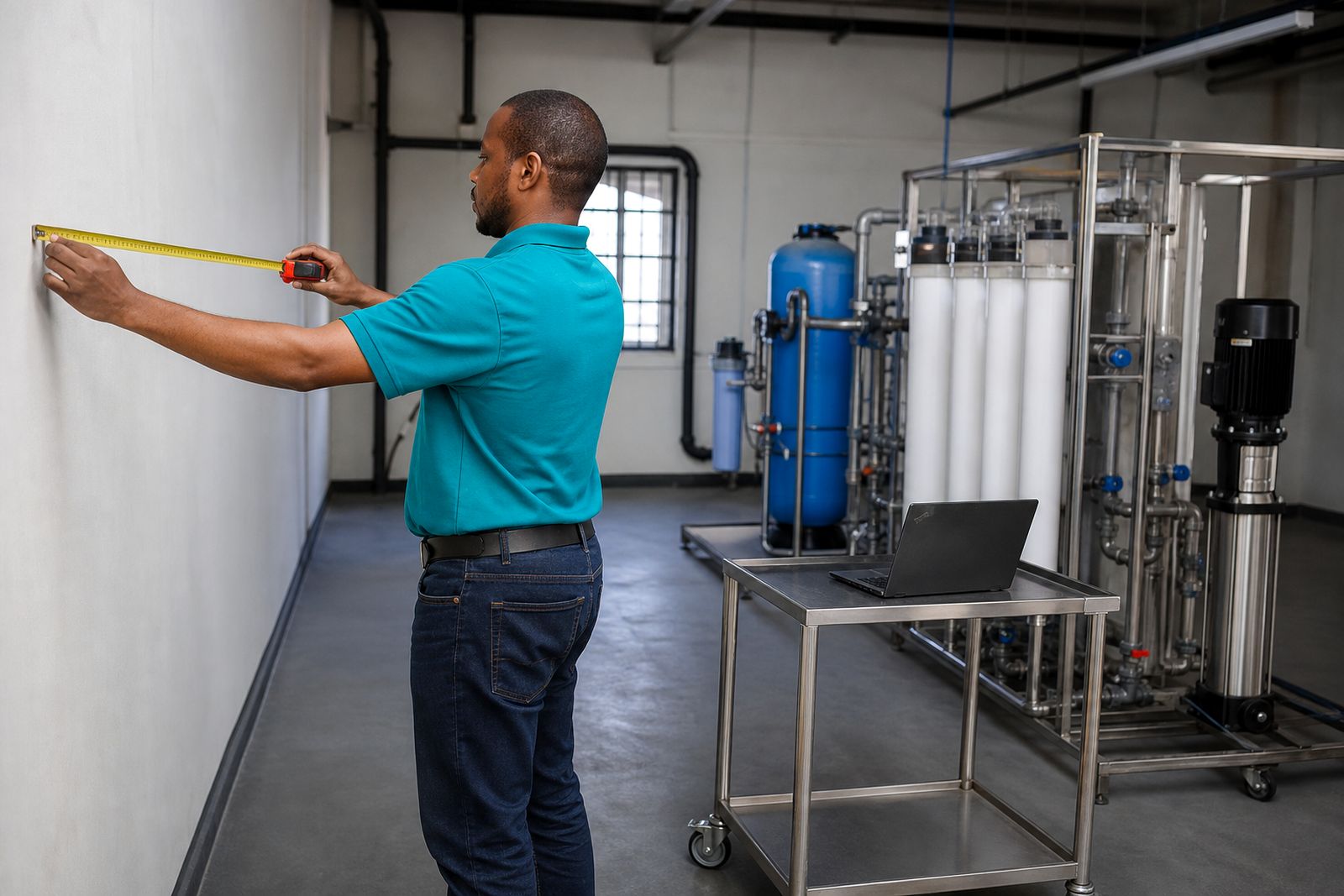
This section explains how we plan and install dialysis water treatment plants for units in Pinetown, greater Durban and across KwaZulu-Natal, with work in other provinces on request. It is the part of the service where the layout on paper becomes a working plant room, with pre-treatment, reverse-osmosis equipment, pipework, drains and the distribution loop all fitted to suit the site.
If you are deciding where to start, use this section in a simple order. Begin with the survey and design page if the unit is still planning the room or replacing older equipment. Go to commissioning if the installation is nearly complete and you want to understand handover, checks and records.
- Site survey and design: for room layout, incoming water checks, drainage, power supply and routing.
- Commissioning: for start-up checks, flushing, documentation and handover to the responsible staff.
From survey to working plant
Every installation starts with the site. We check the incoming water point, floor levels, drain positions, access for moving equipment in, and the route from the plant room to the treatment area. In older buildings around Durban and the Highway area, room access and existing plumbing often decide the practical layout more than the drawing does, so we plan around that early.
During installation we coordinate the placement of pre-treatment vessels, filters, reverse-osmosis stages, storage where required, pumps, control points and the distribution loop. We also look at details that matter on a busy unit, such as safe access for changing filters, space for salt handling, and clear drain falls so there is no standing water left in trays or on the floor.
KwaZulu-Natal conditions can be hard on plant rooms. Coastal humidity near Durban, salt air closer to the shoreline and summer heat all affect how we route pipework and place equipment, and we take that into account before anything is fixed in place.
Choosing between survey and commissioning
These two pages sit in the same section, but they answer different needs.
- Choose site survey and design when: the room is not final yet, the water route is unclear, drainage needs work, or you are replacing an existing plant and want fewer surprises during installation.
- Choose commissioning when: the equipment is already installed or nearly installed, the pipework is in place, and the unit needs start-up checks, flushing, record setup and handover.
- Use both when: you want one team involved from planning through final start-up, which usually makes coordination easier and avoids rework.
A survey focuses on what must be prepared before fitment. Commissioning focuses on proving the plant is ready for operational use. One happens before the install, the other happens at the end, but both are part of the same chain.
Practical points we check before installation starts
A dialysis water plant depends on more than the main equipment. Small site issues can delay work or make future servicing awkward, so we raise them early and agree the route forward with the unit.
- Incoming water isolation and whether it is accessible without entering restricted areas.
- Drain size, fall and discharge point, including any municipal site rules for waste water routing.
- Power supply position and how the unit plans around power cuts.
- Ventilation and room temperature, especially in enclosed plant rooms.
- Door widths, stairs and turning space for bringing equipment into the room.
- Wall and floor condition for mounting, pipe supports and housekeeping.
- Access for routine items such as pre-filters, carbon changeouts and salt deliveries.
Getting these basics right saves time later and helps the responsible staff work safely around the plant every day.
Installation work from tap to drain
Our scope covers the full water path. That includes pre-treatment, filters and softener salt arrangements, reverse-osmosis plant connection, product water routing, the distribution loop, drain lines and the final handover of records related to the installed system. We do not give clinical advice. The unit and its responsible staff set the testing schedule and limits, and we keep the records required for the plant and its service history.
Where a unit is replacing an older setup, we plan the changeover carefully so the new installation ties into the available services with as little disruption as possible. On some sites the cleanest option is a staged switchover, on others a direct replacement works better, it depends on room access and the existing pipe route.
We also look at service practicality from day one. A neatly installed plant is not only easier to inspect, it is easier to disinfect, easier to maintain and less likely to suffer avoidable leaks or blocked drains.
What happens at commissioning and handover
Commissioning is the point where the installed plant is checked as a complete system. We verify flow paths, valve positions, drain behaviour, control responses and the general readiness of the plant room for routine operation. We also make sure the records are in place so the responsible staff can continue with daily checks and scheduled testing.
At handover, the unit receives practical information on the installed arrangement, routine observations and service planning. If service contracts, disinfection support or water-quality testing logs are required after installation, those can be arranged as part of the ongoing support. Clients reach us through the enquiry form on our contact page for new installations, upgrades and follow-up service.


What our Water Treatment customers say
Verified Google reviews
Questions we get asked
Do you only install in Pinetown and Durban?
No. We are based in Pinetown and install and service dialysis water plants across KwaZulu-Natal, with work in other provinces on request.
Can you help if our plant room is still being planned?
Yes. Start with the site survey and design option so the room layout, water route, drainage, access and service space can be checked before installation begins.
Do you set the testing schedule for the unit?
No. The unit and its responsible staff set the testing schedule and limits. We keep the records linked to the plant, testing logs and service history.
Ask about a water plant
Send a note through our contact form with your unit, the number of treatment stations and whether you need a new plant, a service or testing, and an engineer will contact you.
Open the contact form